How to Turn Passive Vocabulary into Active Vocabulary with Koki
Have you ever understood a word completely while reading an article or watching a movie, but found yourself unable to recall it when speaking or writing?
This is one of the most common and discouraging bottlenecks in language learning.
You don’t lack vocabulary knowledge; you are simply trapped in your passive lexicon.
Learning how to turn passive vocabulary into active vocabulary is the bridge between understanding a language and actually speaking it with effortless fluency.
In this guide, we break down why this gap exists and how Koki’s multi-sensory flashcards help you activate words so they roll off your tongue naturally.
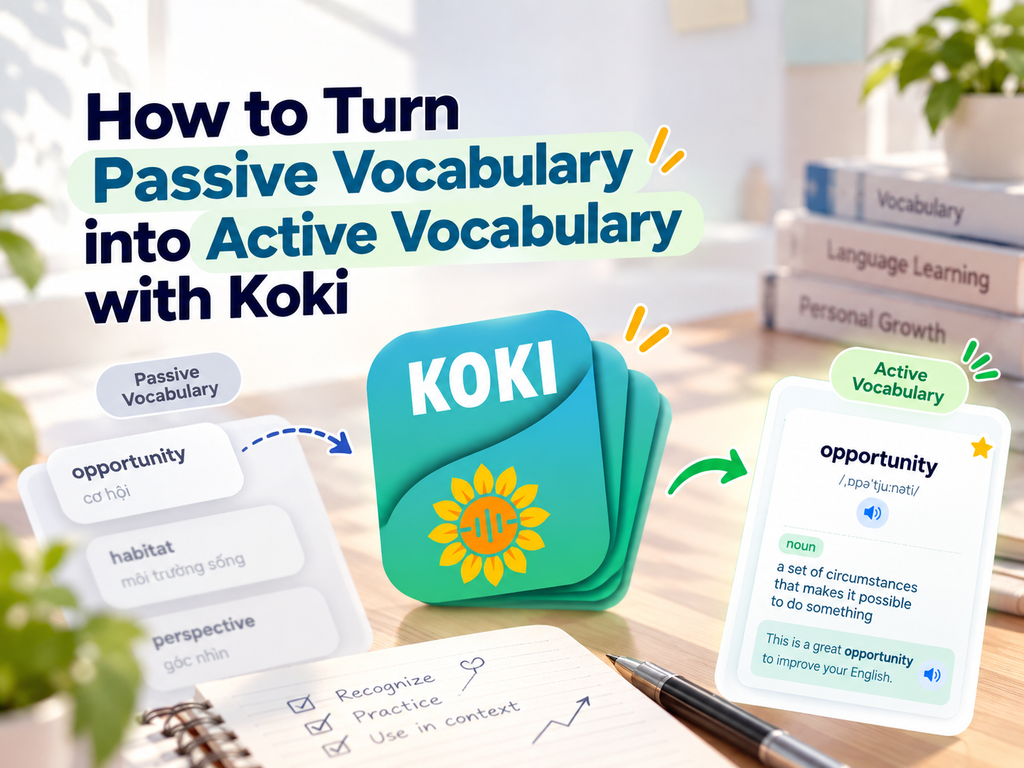
Passive Vocabulary vs Active Vocabulary: What Is the Difference?
Before you can fix the problem, you need to understand the fundamental distinction in passive vocabulary vs active vocabulary:
- Passive Vocabulary: Words you recognize and understand when you hear or read them in context. Your brain relies on external clues to unlock their meaning.
- Active Vocabulary: Words you can retrieve from memory spontaneously and use accurately in your own sentences without hesitation.
For most learners, passive vocabulary is three to four times larger than active vocabulary.
If your study method only consists of looking at flashcards or rereading word lists, you are exclusively training passive recognition.
To speak and write fluently, you must train active production.
Why Knowing a Word’s Meaning Isn’t Enough
Recognizing a word’s translation only creates a surface-level memory trace.
When having an actual conversation, your brain does not have five seconds to search a mental dictionary.
It requires rapid retrieval of:
- Acoustic memory: How the word sounds and feels when your vocal cords produce it.
- Grammatical collocations: Which prepositions and sentence patterns naturally accompany the word.
- Spelling and motor memory: The muscle memory developed by typing or writing the word out.
If you want to know how to use new words in speaking, your daily practice must simulate these exact conditions.
How to Turn Passive Vocabulary into Active Vocabulary with Koki
Koki is designed to take you far beyond simple flashcard recognition.
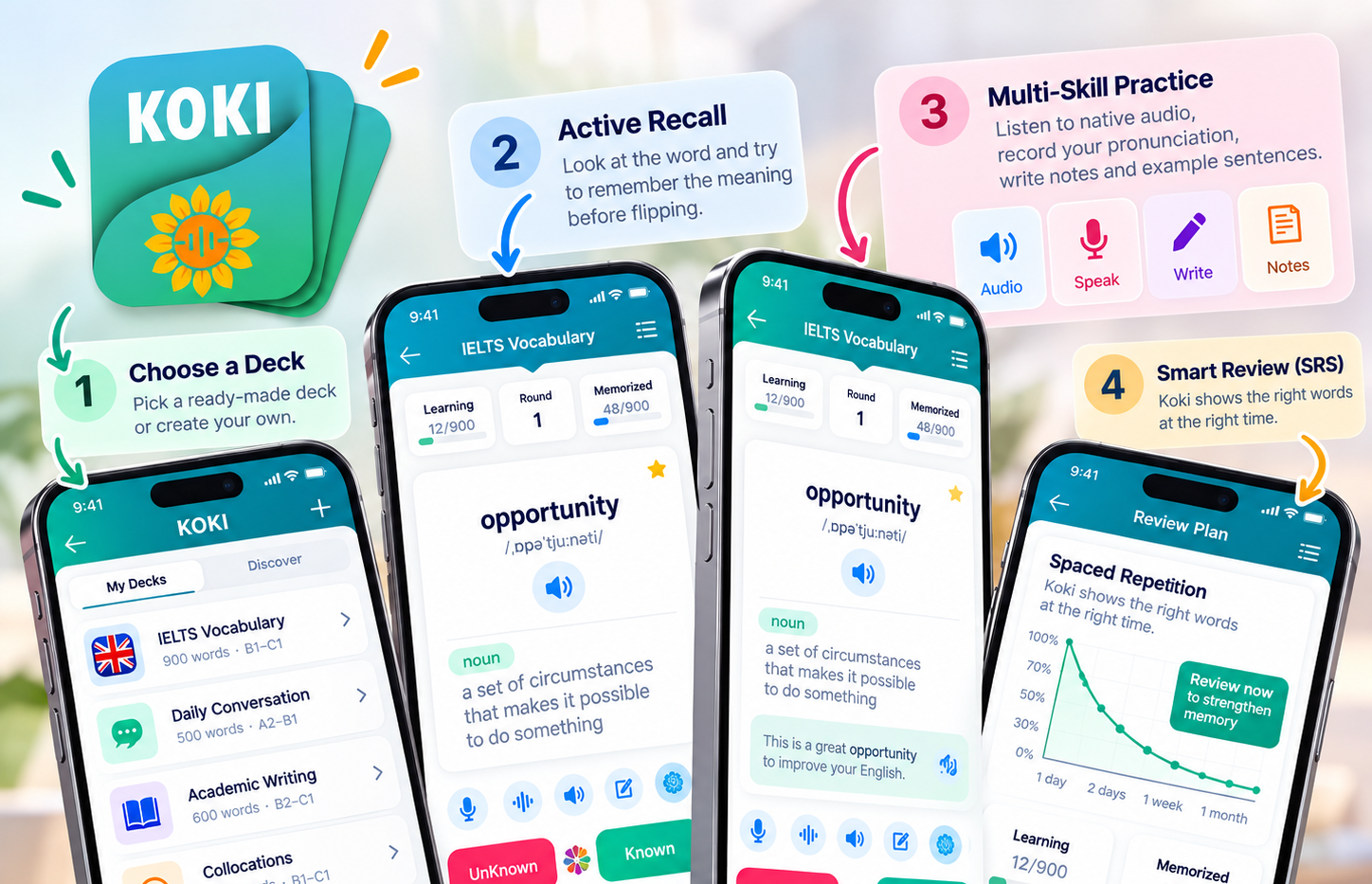
By integrating speech recognition, audio playback, custom notes, and active recall drills, Koki bridges the gap between passive and active mastery:
1. Pronounce Aloud with Voice Practice (Microphone Tool)
You cannot activate words in conversation if your mouth has never spoken them.
- Tap Koki’s Microphone tool on any card to record your pronunciation.
- The app evaluates your speech and provides instant feedback, helping you build vocal muscle memory and master natural cadence.
2. Sharpen Auditory Reflexes with Native Audio
Accurate pronunciation and listening comprehension are deeply connected.
- Use the Speaker button for instant vocabulary pronunciation and listening practice.
- Hearing authentic native accents repeatedly trains your ear to recognize the word instantly in rapid, real-world speech.
3. Build Real Context with the Note & Sentence Feature
Words learned in isolation stay passive. Words learned in personal context become active.
- Tap the Note icon to write your own sentence for any tricky vocabulary term.
- By applying the word to your own thoughts, work tasks, or daily routine, you cement a permanent cognitive anchor in your memory.
4. Reinforce Motor Memory with Writing Mode
In Koki’s Writing mode, you are prompted to type out the target word from memory rather than just selecting it from multiple choices.
This active generation prevents common spelling errors in exams like IELTS or HSK and solidifies the word in your active working memory.
5. Challenge Retrieval Speed in Interactive Quizzes
Koki’s Quiz mode tests your reflex speed under mild time pressure:
- Word Matching: Sharpens instant conceptual association.
- Fill in the Blanks: Exercises your ability to insert active vocabulary into grammatically complete sentences.
- Pronunciation Quiz: Evaluates your real-time speaking accuracy.
3 Daily Habits to Keep Your Vocabulary Active
To make sure your new words stay ready for conversation, use these three practical strategies:
- Speak before you flip: When reviewing a card, speak the word out loud in a full sentence before checking the back.
- Limit daily new cards: Master 10 to 15 words actively rather than skimming 50 passively.
- Review your tagged words: Tag stubborn words and practice using them during your next writing or speaking session.
Speak What You Know with Koki
You already know enough words to communicate effectively; they just need to be brought into your active vocabulary.
When you discover how to turn passive vocabulary into active vocabulary using multi-sensory practice, speaking a foreign language stops feeling like a struggle and starts feeling natural.
Download Koki today, pick your target deck, and transform your passive vocabulary into confident, active fluency!